

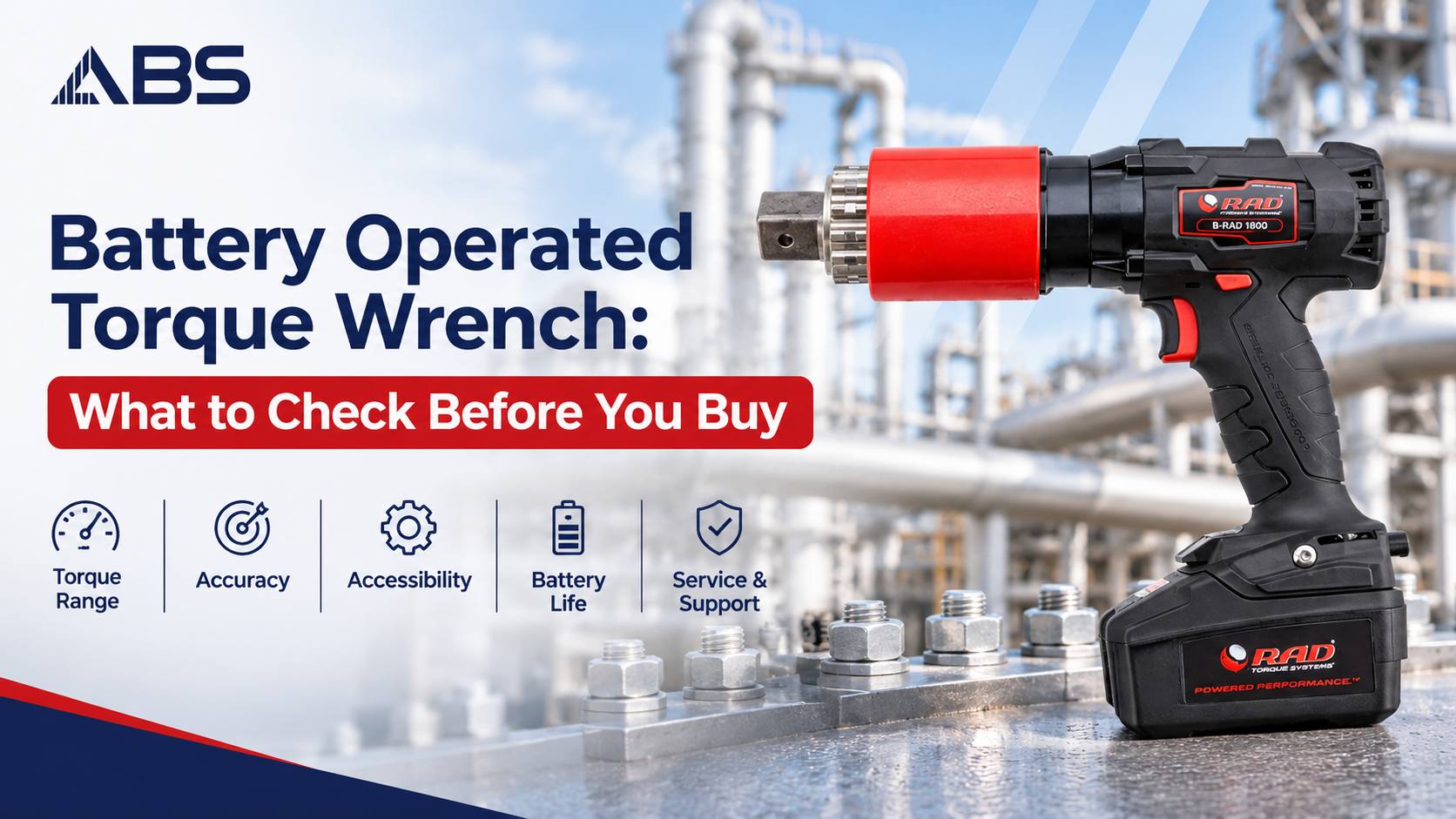
Battery Operated Torque Wrench: What to Check Before You Buy
A battery operated torque wrench is a cordless electric tool that tightens and loosens industrial fasteners to a set torque, with no air compressor, hydraulic pump or power cable. Before you buy one, check six things:
- Whether its torque range covers your bolts
- How accurate it is
- Whether it fits the access you have
- Whether it can handle the size of the job
- What records it gives you
- Who will calibrate and service it
Torque capacity and price are usually the first things buyers compare when choosing a battery torque wrench. However, the right tool also needs to match the bolt sizes, working clearance and tightening requirements at your site. Calibration support and after-sales service are also worth checking before you buy.
What is a battery torque wrench?
A battery torque wrench uses a rechargeable lithium-ion battery to power the tool and tighten fasteners to a preset torque value. It is designed for controlled bolting applications such as flanges, structural joints, turbines and heavy equipment.
Online listings often group three different types of tools together:
- Digital click-type wrench: A hand-operated wrench with an electronic display. The operator applies the force manually, while the display shows the torque reading.
- Cordless impact wrench: A battery-powered tool that uses a hammering mechanism to tighten or loosen fasteners quickly. It is mainly used for fast assembly and removal rather than precise final torque control.
- Battery torque wrench: A motor-driven tool that tightens fasteners to a preset torque. It uses a reaction arm to control the counter-force during operation and is designed for controlled, high-torque bolting.
ABS and the RAD B-RAD Series
ABS supplies the RAD B-RAD range as RAD’s MASTER DISTRIBUTOR. Across its different models, the range covers 70 Nm to 15,000 Nm.
These tools are suitable for various industries, including wind energy, oil and gas, power generation, refineries, steel, cement, railways, manufacturing and industrial maintenance.
1. Torque range: choose based on your application, not just the brochure
Choose a torque tool that comfortably covers your application's required torque range. Avoid selecting a tool that can only just reach your target torque.
Always start with the joint specification or approved bolting procedure. It tells you the required torque for each bolt size and grade.
Before selecting the tool, check two important things with the supplier:
- Accuracy range: At which torque levels does the tool maintain its specified accuracy?
- Operating range: Will your application require the tool to operate near the lower or upper limit of its torque capacity?
Remember, applying the correct torque does not automatically guarantee the required bolt preload. Factors such as thread condition, lubrication and contact-surface friction can affect the final bolt preload. For more information, read our guide to precision torque measurement.
For critical bolted joints, always specify the recommended lubricant along with the required torque value. Using a different lubricant can change friction and affect the resulting bolt preload.
Tip: Select your torque tool based on the actual joint requirements, not just its maximum torque capacity.
2. Accuracy and repeatability: always check both
When selecting a torque tool, accuracy and repeatability are two important factors to consider.
- Accuracy: How close the tool gets to the required torque value.
- Repeatability: How consistently the tool delivers similar torque results across repeated tightening operations.
Both are important for achieving reliable and consistent bolting results.
ABS lists a torque precision of ±4% for the B-RAD Xtreme. For other models, always ask the supplier for the specified accuracy and supporting documentation.
Questions to ask your supplier
- Is the stated accuracy maintained across the entire torque range or only at specific torque settings?
- Does the tool come with a calibration certificate?
- How can the tool's performance be verified at the job site?
A digital torque setting does not, on its own, guarantee a properly tightened joint. The correct tightening procedure is equally important. This includes following the specified tightening sequence, applying torque in multiple passes and completing the required final checks.
Guidelines such as ASME PCC-1 provide recommendations for the assembly of bolted flange joints.
Tip: Don't judge a torque tool by its accuracy figure alone. Also consider its repeatability, calibration and performance under actual working conditions.
3. Accessibility: will the tool fit where you need it?
Before selecting a torque tool, check the available space, reaction point and tool weight at the job site.
A torque wrench with a reaction arm needs a strong and suitable surface to react against. This could be an adjacent nut or an approved flange feature. Make sure the reaction arm is correctly positioned and secure before operating the tool. Always keep your hands clear of the reaction arm and moving parts.
For applications with limited clearance, the B-RAD Select Offset uses an offset gearbox to access bolts that may be difficult to reach with a standard torque wrench.
Tool weight is another important factor. The B-RAD Xtreme models weigh between 10.5 and 19.3 kg. Consider how and where the tool will be used. Handling a heavy tool in an overhead position for an entire shift can be much more demanding than using it at waist or bench height.
Tip: Always check tool clearance, reaction-arm positioning and operator handling before selecting a torque wrench.
4. Battery and job size: count the bolts, not the flanges
Battery torque wrenches are particularly useful at sites where moving hydraulic pumps and hoses would slow down the work. However, applications involving very high torque or continuous tightening may be better handled by a hydraulic system.
Battery runtime depends on the torque setting, the type of application and the working conditions. Because of this, a single runtime figure in a brochure may not give the full picture.
Before selecting a tool, calculate how many bolts need to be tightened and the required torque. Then ask the supplier:
- How many bolts can be tightened on one battery charge at my required torque?
- How many batteries will be needed to keep the work running without delays?
- What backup options are available if the job is larger than expected?
For shutdown projects or remote locations, always plan for extra batteries and suitable charging arrangements before the work starts.
5. Control and records: what the tool tells you afterwards
Before you choose: Decide what proof of tightening your client or inspector will ask for, then check how the tool provides it.
The B-RAD models differ here:
- B-RAD Select: push-button digital torque setting.
- Digital B-RAD: single-increment torque adjustment, torque and angle control, and programmable settings.
- B-RAD S: a built-in transducer, an auditing mode for checking tightened bolts, torque and angle capability, a bolt counter and password protection.
If you need tightening records, find out whether the model gives you a display only, a bolt count, or stored data you can download. Explore the Digital B-RAD cordless torque wrench for digital torque and angle control options.
6. Calibration and service: who services it after the sale?
Why it matters: A torque tool is only as trustworthy as its last calibration, so check where it is calibrated, to which standard, and how long it takes.
ABS offers NABL ISO/IEC 17025-accredited tool calibration at its Navi Mumbai service centre. It issues certificates for audits and QA/QC and can calibrate battery torque wrenches. Confirm the calibration range and certificate type for your tool when you enquire. The National Accreditation Board for Testing and Calibration Laboratories (NABL) is India's accreditation body for testing and calibration laboratories, and ISO/IEC 17025 is the international standard for the competence of those laboratories.
The calibration interval depends on usage, the manufacturer's guidance and your quality system. Annual calibration is common practice. ABS also offers an Annual Maintenance Contract (AMC), tool audits and on-site support through its mobile service van. Learn more about ABS after-sales support. Whoever you buy from, ask where calibration is done, how long it takes and what happens to your tool while it is away.
When a battery torque wrench is not the right choice
A battery torque wrench is not the answer to every job:
- Torque beyond the tool's range: Look at hydraulic torque wrenches.
- Continuous heavy duty or very large bolt counts: Hydraulic or pneumatic tools are often better suited.
- Very little clearance around the nut: A low-clearance tool may be the better route.
Good suppliers will suggest the right tool based on application study.
Battery, hydraulic and pneumatic: at a glance
This is general guidance. Your joint, torque and site conditions decide the final choice.
| Battery | Hydraulic | Pneumatic | |
|---|---|---|---|
| Power | Rechargeable lithium-ion battery | Hydraulic pump and hoses | Compressed air supply |
| Setup on site | Charge the battery, fit the socket and reaction arm | Connect the pump, hoses and tool | Connect the air supply |
| Torque range | B-RAD range up to 15,000 Nm | Typically the choice for the highest torque | Medium to high |
| Mobility | No hoses or cables | Pump and hoses to manage | Air line to manage |
| Best suited to | Remote jobs, quick setup, controlled digital torque | Highest torque, large bolts, heavy duty | Sites with an air supply, repeat tightening |
Matching the job to the B-RAD range
| Model | Torque range | Suits |
|---|---|---|
| B-RAD Select | 170 to 7,000 Nm | Controlled bolting with push-button digital torque |
| B-RAD Select Offset | 170 to 7,000 Nm | Tight flanges, pre-torque and service jobs |
| Digital B-RAD | 70 to 4,000 Nm | Torque and angle, programmable settings |
| B-RAD S | 70 to 7,000 Nm | Auditing and quality checks, bolt counter |
| B-RAD Xtreme | 340 to 15,000 Nm | Extreme-duty bolting, ±4% torque precision |