

Calibration Bench
Calibration Bench
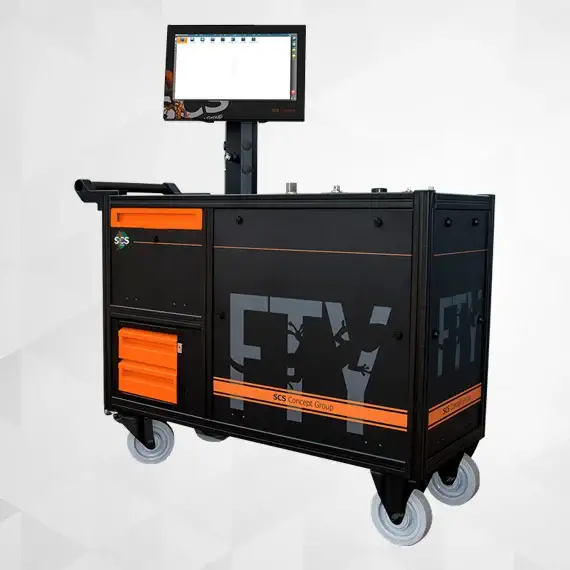
The SCS FTY Dynamic Tester is the industry's most advanced solution for power tool and torque wrench calibration, testing, and analysis. Designed to verify performance up to 1000 Nm, the FTY bench provides traceable, certified results by uniquely reproducing real joint behavior during the test cycle.
The FTY tester is an indispensable tool for Quality Control (QC) and laboratory environments, offering dynamic testing capabilities that runs 40%faster than any other comparable bench on the market today. It ensures all your tightening instruments—from electronic wrenches to pneumatic pulse tools—meet stringent international standards like ISO 6789 and ISO 5393
Read Less
Read More
The FTY Dynamic Tester is engineered for complex joint simulation and statistical process control
Dynamic Joint Simulation
Reproduces real joint behavior, simulating fastening across all stages: Engage, Drawdown, and Joint Stiffness. It can simulate fasteners completely loosed or pre-tightened.
Reproduces real joint behavior, simulating fastening across all stages: Engage, Drawdown, and Joint Stiffness. It can simulate fasteners completely loosed or pre-tightened.
Comprehensive Tool Testing
Capable of testing virtually all power tools and wrenches, including electronic/digital wrenches, click wrenches, pneumatic, electric, battery tools, and pulse tools.
Capable of testing virtually all power tools and wrenches, including electronic/digital wrenches, click wrenches, pneumatic, electric, battery tools, and pulse tools.
Advanced Statistics
Performs Statistical Process Control (SPC), including the measurement of machine capability (Cm, Cmk).
Performs Statistical Process Control (SPC), including the measurement of machine capability (Cm, Cmk).
Click Point Auto Detection
Features an automatic click point detection feature specifically for click wrenches.
Features an automatic click point detection feature specifically for click wrenches.
Customization
Fully customized in hardware, transducer configuration, and statistical reports to meet precise requirements.
Fully customized in hardware, transducer configuration, and statistical reports to meet precise requirements.
Statistical Analysis
Stores full results and traces, enabling statistical analysis and traceable torque/angle or torque/time reporting.
Stores full results and traces, enabling statistical analysis and traceable torque/angle or torque/time reporting.
Universal Connectivity
Supports connectivity with many industry protocols for tool programming and reports.
Supports connectivity with many industry protocols for tool programming and reports.
Let's discuss further to get better results
Frequently Asked Questions
You will find answers to about our various industries and industry specialists service and more. Please feel
free to contact us if you don't get your question's answer in below.
free to contact us if you don't get your question's answer in below.
A calibration bench is a testing system used to verify the accuracy and performance of torque tools and fastening equipment under controlled conditions.
The FTY Dynamic Tester provides 0.5% torque accuracy of readout ±1 digit from 20% to 100% of cell capacity and ±1° angle accuracy over 360°.
Yes. The system provides traceable torque/angle and torque/time reporting, with angle accuracy of ±1° over 360°.
Yes. It is designed for quality control and laboratory environments and includes statistical process control capabilities such as machine capability measurements (Cm and Cmk).