

Bolt Load Measurment
Bolt Load Cells
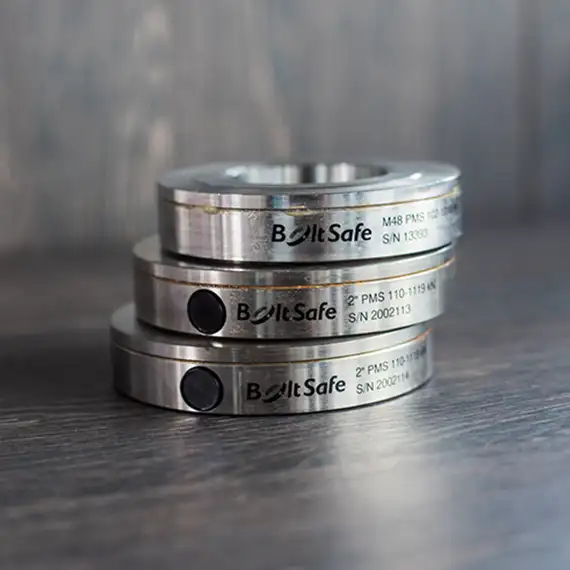
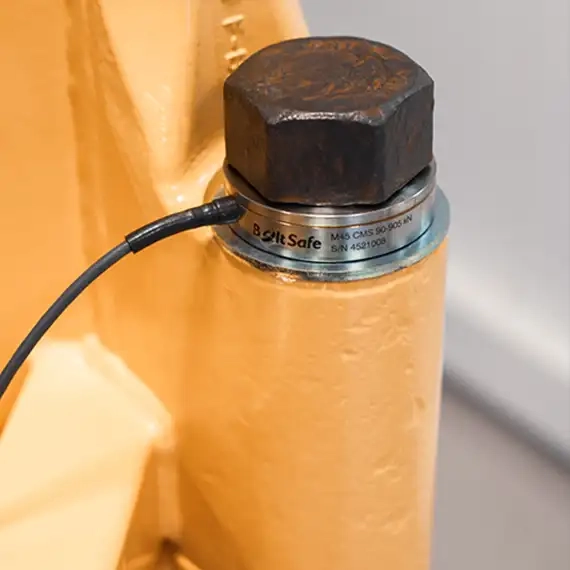
ABS is the official distributor in India for BoltSafe Bolt Load Cells—specialized, highly accurate load sensors designed to monitor the actual bolt load in bolted joints. Installed like a simple washer, these sensors utilize proprietary magnetoelastic technology instead of conventional strain gauges to measure the subtle deformation caused by tightening, ensuring the load value is determined precisely, not assumed or guessed.
Using BoltSafe load cells eliminates uncertainties about the bolt load, leading to enhanced safety, more reliable joints, and better structural control while reducing installation and maintenance costs throughout the joint's lifespan.
Read Less
Read More
BoltSafe load cells are built on advanced ASIC technology for robust digital performance
ASIC Technology & Traceability
Each sensor is equipped with an integrated ASIC (Application-Specific Integrated Circuit) that enables advanced digital communication and signal processing. Every sensor carries a unique serial number, ensuring complete individual traceability.
Each sensor is equipped with an integrated ASIC (Application-Specific Integrated Circuit) that enables advanced digital communication and signal processing. Every sensor carries a unique serial number, ensuring complete individual traceability.
Superior Accuracy
Provides highly precise measurements with a maximum deviation of just 1% of full scale after factory calibration.
Provides highly precise measurements with a maximum deviation of just 1% of full scale after factory calibration.
Magnetoelastic Principle
Uses changes in the magnetic field across the entire ring surface—unlike strain gauges—resulting in a more compact, stable, and drift-free design.
Uses changes in the magnetic field across the entire ring surface—unlike strain gauges—resulting in a more compact, stable, and drift-free design.
Rugged Durability
Built to IP66 standards for dust and water resistance. Designed to withstand demanding environments, including exposure to oil, seawater, and temperatures ranging from −40°C to +80°C.
Built to IP66 standards for dust and water resistance. Designed to withstand demanding environments, including exposure to oil, seawater, and temperatures ranging from −40°C to +80°C.
High-Strength Option
Also available in a reinforced variant capable of handling 15% higher load capacity while maintaining identical compact dimensions.
Also available in a reinforced variant capable of handling 15% higher load capacity while maintaining identical compact dimensions.
Temperature Monitoring
The digital monitoring system measures not only bolt load but also the sensor’s temperature for enhanced operational insight.
The digital monitoring system measures not only bolt load but also the sensor’s temperature for enhanced operational insight.
Eliminate uncertainty. Monitor your actual bolt load with BoltSafe precision.
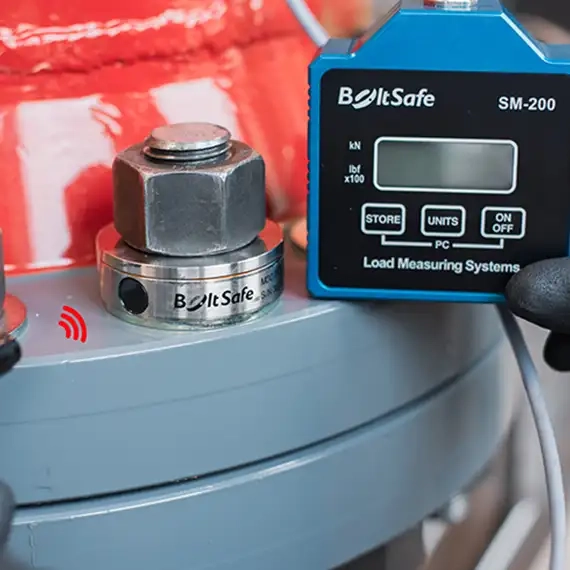
ABS offers two primary systems for load monitoring, designed for different operational requirements:
Related Products
A major issue with bolted connections is the uncertainty of achieving or maintaining the required bolt load, often leading to problems like gasket joint leaks due to uneven or insufficient loading. BoltSafe addresses these bolting issues with its innovative solution: the BoltSafe bolt load cell, which functions as a washer on bolted connections.
Let's discuss further to get better results
Frequently Asked Questions
You will find answers to about our various industries and industry specialists service and more. Please feel
free to contact us if you don't get your question's answer in below.
free to contact us if you don't get your question's answer in below.
Bolt load cells are specialized load sensors installed like a washer on a bolted joint to measure the actual bolt load or tension directly, helping verify joint integrity and tightening performance.
BoltSafe load cells use magnetoelastic technology to detect changes caused by bolt loading and determine the actual load in the joint, rather than estimating bolt tension from applied torque.
The CMS (Continuous Monitoring System) provides real-time and historical bolt-load data and can monitor multiple interconnected sensors. The PMS (Periodic Monitoring System) uses a non-contact handheld probe for on-demand measurements and is useful for confined or difficult-to-access locations.
Yes. The BoltSafe CMS system is designed for continuous monitoring of critical bolted joints and can provide real-time and historical bolt-load data.
Yes. BoltSafe load cells are designed to IP66 standards and can operate in demanding environments, including exposure to oil and seawater, across temperatures from −40°C to +80°C.
Yes. The digital monitoring system can measure both bolt load and sensor temperature, providing additional information about the operating condition of the joint.