

Bolt Load Measurment
PMS Bolt Load Cell
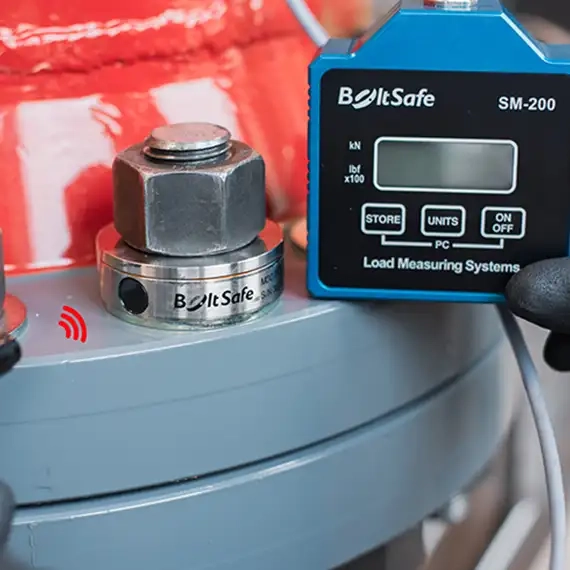
The PMS Bolt Load Cell is a robust, "fit-and-forget" solution designed for long-term monitoring of bolted joint integrity. Unlike active electronic sensors that require constant power, the Passive Monitoring System is engineered for durability in extreme environments, allowing operators to capture precise bolt tension data on- demand during routine inspections.
Wireless Data Retrieval
Uses RFID or NFC technology to transmit load and tension data to a handheld reader, eliminating the need for complex cabling.
Uses RFID or NFC technology to transmit load and tension data to a handheld reader, eliminating the need for complex cabling.
Zero-Power Operation
The load cell remains dormant and requires no internal battery, drawing power only when scanned by the reader.
The load cell remains dormant and requires no internal battery, drawing power only when scanned by the reader.
High Precision
Provides accurate measurement of actual bolt elongation and clamp load rather than relying on estimated torque values.
Provides accurate measurement of actual bolt elongation and clamp load rather than relying on estimated torque values.
Harsh Environment Readiness
Hermetically sealed and resistant to corrosion, vibration, and extreme temperatures, making it ideal for offshore and subsea applications.
Hermetically sealed and resistant to corrosion, vibration, and extreme temperatures, making it ideal for offshore and subsea applications.
Let's discuss further to get better results
Frequently Asked Questions
You will find answers to about our various industries and industry specialists service and more. Please feel
free to contact us if you don't get your question's answer in below.
free to contact us if you don't get your question's answer in below.
Bolt load measurement is the process of accurately determining the actual clamping force (tension) in a bolted joint. It is critical in safety-sensitive applications such as wind energy, oil & gas, power plants, mining, and heavy machinery, where incorrect bolt tension can lead to joint failure, leaks, vibration, or structural damage.
Smart sockets measure bolt load by directly sensing the applied load or elongation of the bolt during tightening or inspection. Unlike conventional torque tools, smart sockets provide real-time, repeatable, and accurate bolt load data, eliminating errors caused by friction, lubrication, or surface conditions.
Ultrasonic (often called sonic or solar) bolt load measurement uses high-frequency sound waves to measure the elongation of a bolt, which directly correlates to bolt tension. This method is highly accurate and is widely used for critical bolted joints, large-diameter bolts, and applications where torque methods are unreliable.
Bolt load measurement systems are commonly used in:
Wind turbine installation & maintenance
Oil & gas pipelines and flanges
Power generation plants
Steel structures & heavy fabrication
Mining and cement plants
Aerospace and heavy equipment manufacturing
These systems help ensure joint integrity, safety compliance, and repeatable assembly quality.
Calibration ensures that bolt load measurement equipment delivers accurate and traceable results. Regular calibration using certified calibration systems helps maintain measurement reliability, meet quality standards, and comply with audit and safety requirements in industrial environments.
Torque tightening only estimates bolt tension and is heavily affected by friction, surface finish, and lubrication. Bolt load measurement directly measures actual bolt tension, resulting in higher accuracy, reduced joint failures, improved reliability, and longer equipment life, especially in critical bolting applications.